
Planting Shade: Where New Jersey's New Heat Program Could Do the Most Good
The news
Less than a month after the June heat wave (my satellite heat post), the New Jersey Board of Public Utilities (NJBPU) announced a $5 million Urban Heat Island Mitigation Program on July 17, 2025. The program will fund projects in overburdened municipalities in three categories: large neighborhood projects such as tree canopy and green infrastructure (up to $1 million each), cooling upgrades to public buildings and cooling centers (up to $500,000), and small community-led projects such as shaded bus stops and water stations (up to $50,000). NJBPU named Newark, Trenton, Camden, and Jersey City among the most intense heat islands in the Northeast (NJBPU, 2025).
Trees are one of the most effective ways to cool a neighborhood. They shade streets and buildings and release water vapor, and both effects lower temperatures (U.S. EPA, n.d.). Research across 37 U.S. cities has found that neighborhoods historically denied investment have much less tree canopy today (Locke et al., 2021). Where is New Jersey shortest on shade?
Data
NJDEP’s environmental justice dataset includes two measures for every census block group: lack of tree canopy and impervious surface (pavement and buildings). I used the version in effect in July 2025 and combined it with the municipal surface temperatures I calculated from Landsat in my satellite heat post.
Findings
Overburdened communities have much less shade
The average resident of an overburdened community lives in a block group with 23.8% tree canopy, compared with 41.3% for other residents. Pavement shows the reverse: 58.2% impervious surface in OBCs versus 33.1% elsewhere (Figure 1).
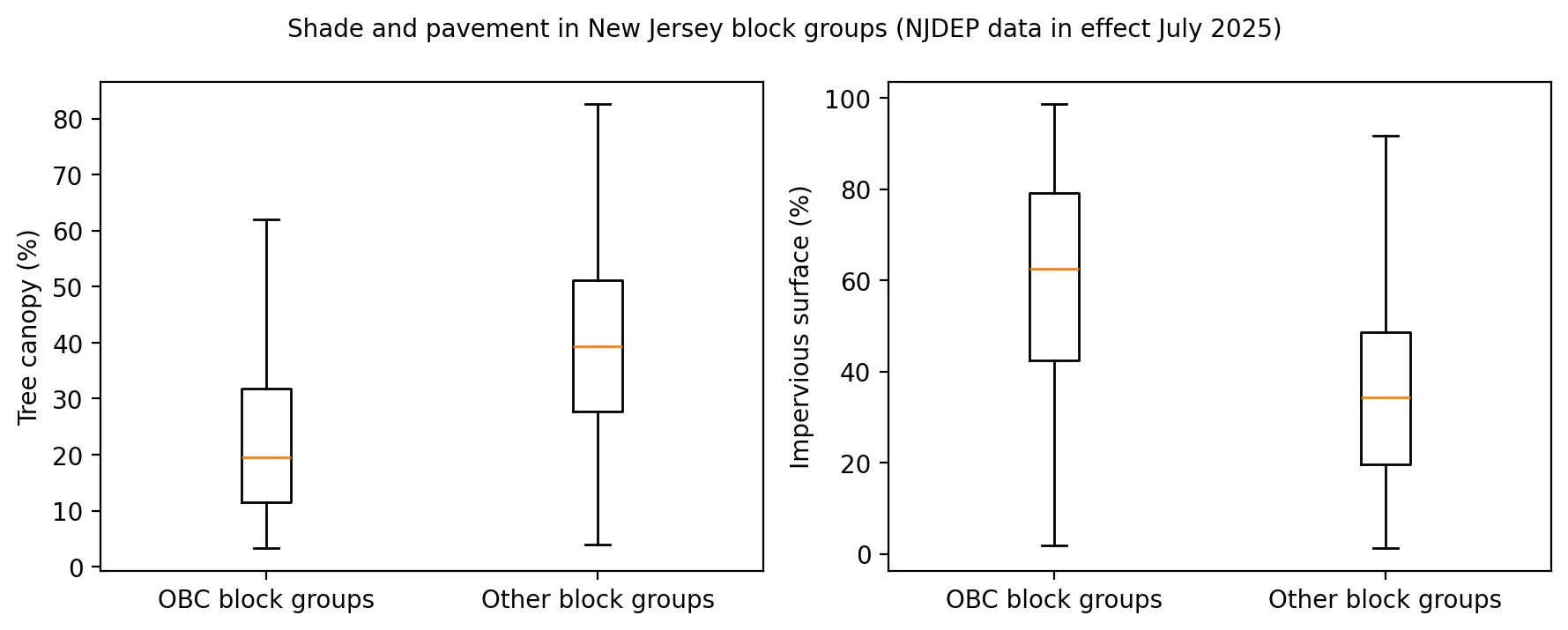 Figure 1. Overburdened block groups have less tree canopy and more pavement than other block groups.
The 655 block groups with the least canopy (the bottom 10%, with less than 8.6% canopy) are home to about 858,000 people, and 81% of them are OBCs. They are concentrated in Jersey City (108 block groups), Newark (60), Elizabeth (49), Union City (40), Paterson (40), Bayonne (38), Hoboken (26), and Atlantic City (24).
Separating trees from pavement
Places with fewer trees are hotter, but they also tend to have more pavement. Which matters more? A multiple regression estimates the effect of each factor while holding the other constant. Across 524 municipalities:
| Model | Tree canopy (°C per +1 percentage point) | Impervious surface (°C per +1 pt) | OBC share (°C, 0 → 100%) | R² |
|---|---|---|---|---|
| Canopy only | −0.18 | — | — | 0.72 |
| Canopy + impervious | −0.06 | +0.10 | — | 0.83 |
| Canopy + impervious + OBC share | −0.06 | +0.09 | +1.1 | 0.84 |
All coefficients are statistically significant (p < 0.001).
Three lessons stand out. First, tree canopy alone explains a lot (R² = 0.72). Second, part of that “tree effect” is really pavement: once impervious surface is included, the canopy coefficient shrinks from −0.18 to −0.06. Both matter. Each additional percentage point of canopy is associated with about 0.06°C of cooling, and each point of pavement with about 0.10°C of warming. Third, even after accounting for trees and pavement, municipalities with more OBC residents are slightly hotter (about 1°C from 0% to 100% OBC). That suggests other factors, such as building density, roof materials, and lack of parks, also play a role.
 Figure 2. Municipalities with less tree canopy are hotter, and those with a high share of overburdened residents cluster at low canopy and high heat.
What this means for the heat program
A $5 million program cannot plant its way out of the problem, since mature canopy takes decades to grow. But the data point to clear priorities:
- Target the canopy gap. The lowest-canopy block groups are overwhelmingly in overburdened communities in Hudson, Essex, Union, and Passaic counties.
- Combine trees with cool surfaces. Because pavement independently adds heat, cool roofs, lighter pavement, and removing unnecessary asphalt can work alongside tree planting, and they help faster.
- Plan for maintenance. Young trees need watering and care for years. Grants that pay only for planting risk losing trees before they provide shade.
Limitations
- Correlation, not causation. The regression shows associations across towns, not the effect of planting a specific tree.
- Different years. Canopy and impervious data come from NJDEP’s land cover sources, while the temperatures come from summer 2024.
- Municipal averages hide large differences within towns.
Code project (Level 2): multiple regression
Goal: Compare shade and pavement between OBCs and other block groups, then separate their effects on municipal heat.
Data: NJDEP EJ Law stressor data (version effective Jan 31, 2025 – Mar 30, 2026): lack of tree canopy and impervious surface; municipal summer surface temperatures from my satellite heat post.
Method:
- Convert “lack of canopy” to canopy (100 − value) and compute population-weighted averages.
- Find the bottom 10% of block groups by canopy and count OBCs and residents.
- Assign block groups to municipalities with a spatial join. Lesson learned: NJDEP’s dataset fills in the municipality name only for OBC block groups, so the name column can’t be used directly.
- Fit three regressions with
statsmodels, adding one predictor at a time, and watch how the coefficients change.
import statsmodels.formula.api as smf
m1 = smf.ols("anom ~ canopy", data=towns).fit()
m2 = smf.ols("anom ~ canopy + impervious", data=towns).fit()
print(m2.params, m2.rsquared)
New skill: multiple regression. When two predictors are correlated, a one-variable model can give one of them credit that belongs to the other.
Data and methods
Data sources
- NJDEP EJ Law stressor data (version effective Jan 31, 2025 – Mar 30, 2026): lack of tree canopy and impervious surface; municipal summer surface temperatures from my satellite heat post.
The analysis was done in Python with public data. The full code, its data, and every figure it produces are in the code project below.
References
- Locke, D. H., Hall, B., Grove, J. M., Pickett, S. T. A., Ogden, L. A., Aoki, C., Boone, C. G., & O'Neil-Dunne, J. P. M. (2021). Residential housing segregation and urban tree canopy in 37 US cities. npj Urban Sustainability, 1, 15. https://doi.org/10.1038/s42949-021-00022-0
- New Jersey Board of Public Utilities. (2025, July 17). NJ announces $5 million grant program to combat deadly urban heat [Press release]. https://www.nj.gov/bpu/newsroom/2025/approved/20250717.html
- New Jersey Department of Environmental Protection. (2025). Environmental Justice (EJ) Law Combined Stressor Summary (version effective Jan 31, 2025 – Mar 30, 2026) [Data set]. https://www.arcgis.com/home/item.html?id=8a9ae7bae7a0458fb0f8d3759b145257
- U.S. Environmental Protection Agency. (n.d.). Using trees and vegetation to reduce heat islands. https://www.epa.gov/heatislands/using-trees-and-vegetation-reduce-heat-islands