
The Court Upholds the Rules: What the Appellate Division Decided, and Can We Check NJDEP's Math?
The ruling
On January 5, 2026, a three-judge panel of New Jersey’s Appellate Division unanimously upheld the rules NJDEP adopted in 2023 to carry out the Environmental Justice Law (In re NJDEP’s EJ Rules, 2026). The challenge, brought in 2023 by the New Jersey chapter of the Institute of Scrap Recycling Industries and a labor-management cooperative of Operating Engineers Local 825 (the introduction), argued that NJDEP had exceeded its authority. The court rejected every argument. Its key holdings:
- “New facility” can include changed or unpermitted facilities. The court accepted NJDEP’s definition, which treats existing facilities that change how they operate in ways that increase pollution, or that had operated without required permits, as “new.” That matters because the law requires NJDEP to deny permits for new facilities that would add to an overburdened community’s burden. The court said delinquent facilities should not be “rewarded” with the gentler treatment given to lawful ones (pp. 22–24).
- Jobs cannot offset pollution. The law lets NJDEP approve a new facility only if it serves a “compelling public interest” in the community. NJDEP’s rules say economic benefits like jobs and taxes do not count, and the court agreed: “neither DEP nor applicants for approvals are allowed to trade fewer pollution reductions for more jobs and tax rateables” (pp. 29–30).
- The comparison method is reasonable. NJDEP compares each community with the lower of the state and county medians, and the court found that hybrid approach within NJDEP’s discretion (pp. 30–33).
- Facilities next to OBCs count. Facilities in zero-population industrial block groups that border an OBC are covered (pp. 36–40).
- The mapping tool didn’t need formal rulemaking. NJDEP’s EJMAP and technical guidance are “informational” (pp. 64–68).
Environmental justice groups celebrated (Earthjustice, 2026). The New Jersey Business & Industry Association, which had supported the challengers, said it was disappointed (NJBIA, 2026). The challengers could still ask the New Jersey Supreme Court to review the case.
Can anyone check NJDEP’s work?
A recurring criticism of environmental justice screening is that it can feel like a “black box.” The court called NJDEP’s mapping tool informational, which raises a fair question: can someone outside the agency reproduce its results from public data? I tried, using the dataset version in effect when the court ruled.
How the test works
For each of 26 stressors, such as air pollution, traffic, contaminated sites, flooding, and lack of tree canopy:
- Take all block groups that are not overburdened and find the median value statewide and in each county. The lower of the two is the “geographic point of comparison.”
- A stressor is adverse in a block group if its value is above that comparison point.
- The Combined Stressor Total (CST) counts the adverse stressors.
- An OBC is “subject to adverse cumulative stressors” if its CST is above the CST comparison value, calculated the same way. In those OBCs, new covered facilities face the law’s strictest standard.
Results
Starting only from each block group’s raw values, my calculation matched NJDEP’s published results almost perfectly:
| Check | Agreement with NJDEP |
|---|---|
| “Adverse” flags (24 median-based stressors) | 99.77%–100% (mean 99.97%) |
| Combined Stressor Total | 99.38% identical |
| Final “adverse cumulative stressors” determination | 100% |
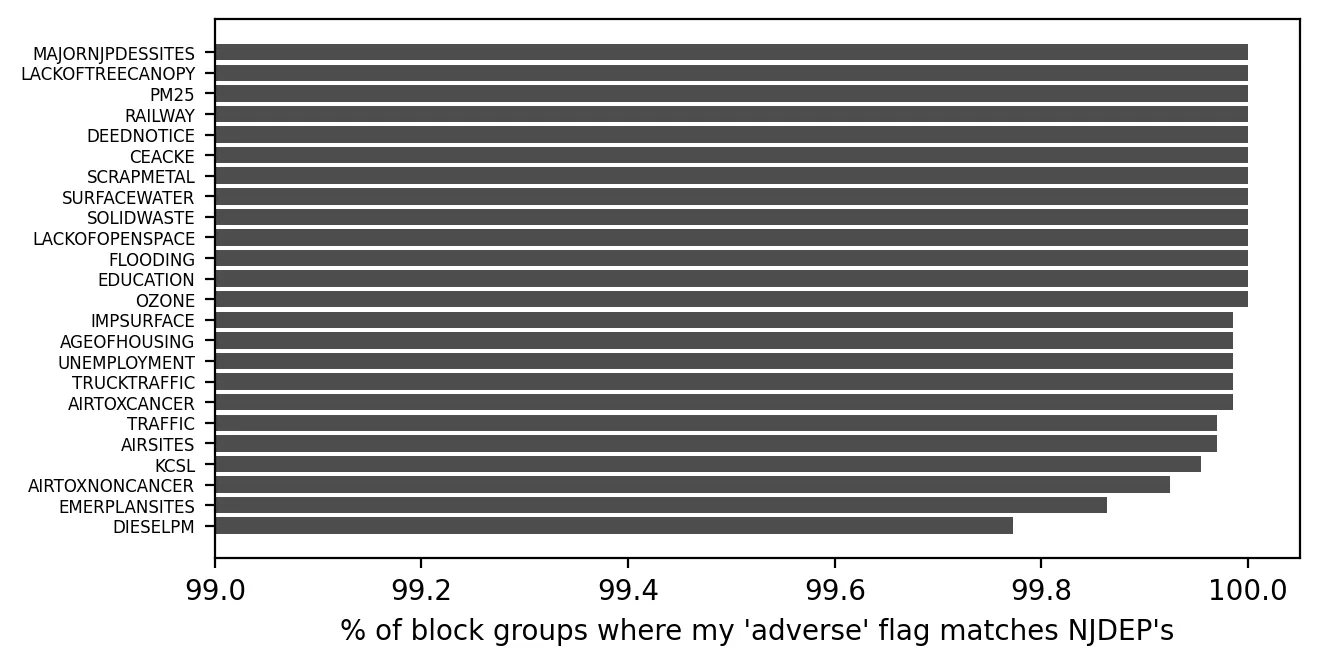 Figure 2. The replicated stressor flags match NJDEP’s in more than 99.7% of block groups for every indicator.
The small differences in individual flags come from block groups with values almost exactly at the median, where rounding decides the outcome. None of them change any community’s final status.
What the test says about New Jersey
Under the data version in effect in January 2026, 3,124 of 3,637 OBCs (85.9%), home to about 4.5 million people, were subject to adverse cumulative stressors. The statewide non-OBC median CST was 13, while county medians ranged from 10 to 18. Because NJDEP uses the lower of the two, no county’s comparison value can exceed 13. That design gives OBCs in heavily industrial counties like Hudson the same protection as everywhere else.
 Figure 1. Where the Environmental Justice Law’s strictest standard applies, by county, with Hudson at 100% and Hunterdon lowest at about 60%.
Why replication matters
The court’s ruling rests partly on the idea that NJDEP’s method is transparent and its tool merely displays public data. This exercise supports that view: the method can be reproduced exactly from published inputs with about 50 lines of code. Reproducibility is also how a community group, an industry applicant, or a student can check whether a particular block group was classified correctly.
Limitations
- I used NJDEP’s published values for two stressors (combined sewer overflows and drinking water) that follow presence or exceedance rules rather than medians.
- Reproducing the calculation does not test whether the underlying data are accurate. That would require checking each of the 26 source datasets.
Code project (Level 3): reproducing an official method
Goal: Recompute NJDEP’s adverse stressor flags, Combined Stressor Totals, and cumulative-stressor determinations, and measure agreement.
Data: NJDEP EJ Law Combined Stressor Summary (version effective Jan 31, 2025 – Mar 30, 2026).
Method:
- Define the comparison pool as all non-OBC block groups.
- For each stressor, compute the state median and county medians, take the lower one, and flag values above it.
- Count flags (with drinking water as one combined stressor) to get the CST.
- Compute the CST comparison value the same way and compare.
- Measure agreement with NJDEP’s published columns.
gpc = np.minimum(pool[f"{s}_BG"].median(), g.COUNTY.map(pool.groupby("COUNTY")[f"{s}_BG"].median()))
flags[s] = g[f"{s}_BG"] > gpc
agreement = (flags[s] == g[f"{s}_ADVERSEHIGHER"].eq("Yes")).mean()
New skill: treating replication as a test. The point is not only to get an answer but to check that it matches an independent source, and to explain any differences.
Data and methods
Data sources
- NJDEP EJ Law Combined Stressor Summary (version effective Jan 31, 2025 – Mar 30, 2026).
The analysis was done in Python with public data. The full code, its data, and every figure it produces are in the code project below.
References
- Earthjustice. (2026, January 5). Victory: NJ appellate court affirms legality of environmental justice law [Press release]. https://earthjustice.org/press/2026/victory-nj-appellate-court-affirms-legality-of-environmental-justice-law
- In re New Jersey Department of Environmental Protection's April 17, 2023, 55 N.J.R. 661(b) "Environmental Justice Rules," Nos. A-2936-22, A-2959-22 (N.J. Super. Ct. App. Div. Jan. 5, 2026). https://www.njcourts.gov/system/files/court-opinions/2026/a2936-22a2959-22.pdf
- New Jersey Business & Industry Association. (2026, January 5). NJBIA responds to appellate court decision on EJ law rulemaking. https://njbia.org/njbia-responds-to-appellate-court-decision-on-ej-law-rulemaking/
- New Jersey Department of Environmental Protection. (2025). Environmental Justice (EJ) Law Combined Stressor Summary (version effective Jan 31, 2025 – Mar 30, 2026) [Data set]. https://www.arcgis.com/home/item.html?id=8a9ae7bae7a0458fb0f8d3759b145257
- Waste Dive. (2026, January 7). New Jersey court upholds key environmental justice law. https://www.wastedive.com/news/new-jersey-environmental-justice-lawsuit-updeld-rema-isri/808999/